
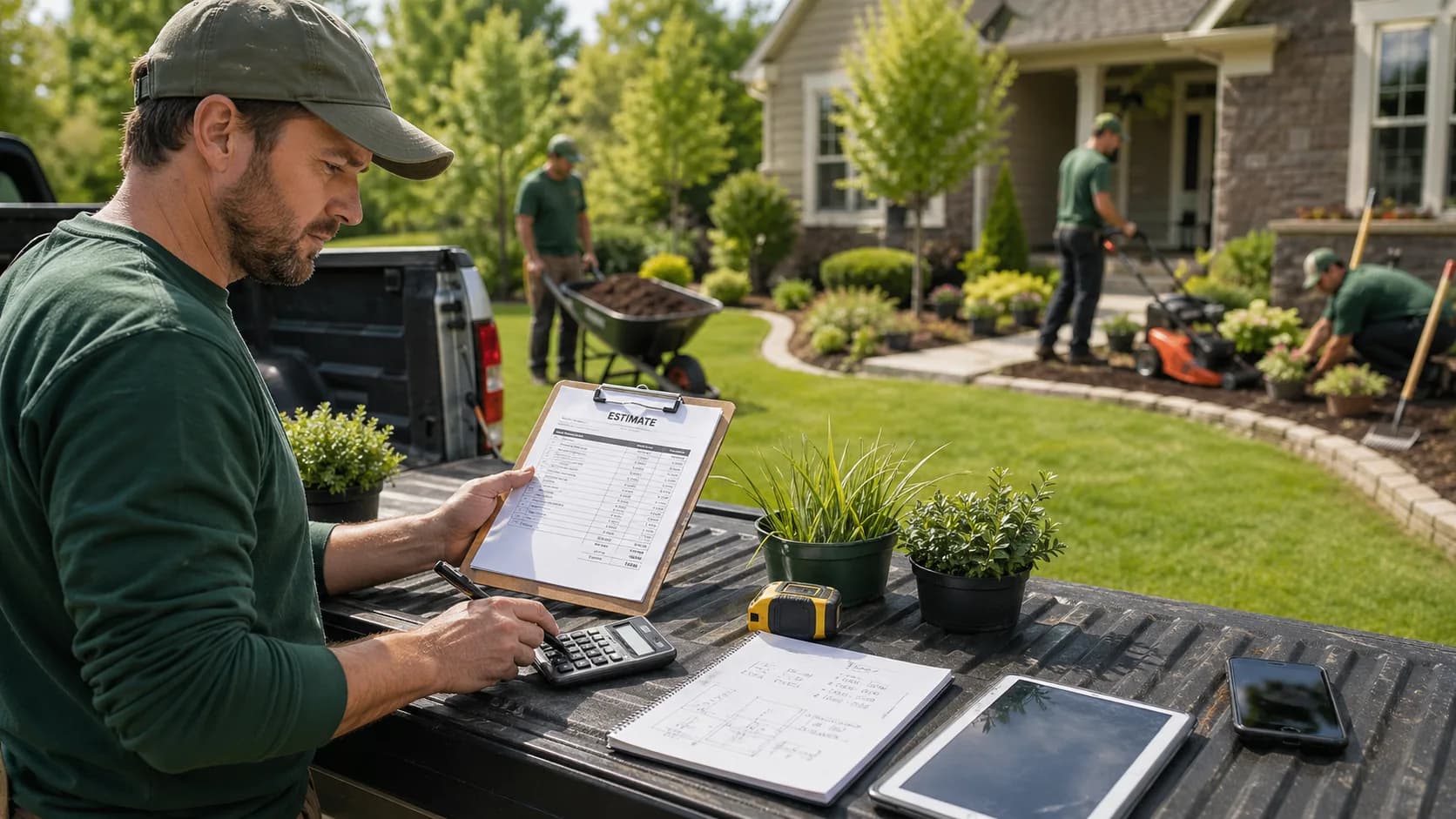
We're in the green industry because we love the work, not because it's a "get rich quick" scheme. But passion doesn't cover payroll, equip your crews, or keep the lights on.
If you are pulling up to a property and "eyeballing" your quotes, you are actively sabotaging your own profitability. Before you launch your next marketing campaign or pitch a new client, you need a bulletproof, data-driven pricing strategy. Here is how to build one.
Phase 1: Market Reconnaissance
If you are starting from scratch, don't guess—research. The landscaping and tree care community is uniquely collaborative; use that to your advantage.
- Network with adjacent pros. Find companies in your area that target different demographics or offer complementary services (e.g., if you design high-end hardscapes, talk to a volume-based mow-and-blow operator). Ask them for a few minutes of their time to discuss pricing structures.
- Mine the digital community. Tap into the massive network of professionals on Reddit, Facebook, LinkedIn, and niche hubs like TreeBuzz. These forums are packed with veterans willing to share their operational baselines.
- Reverse-engineer quotes ethically. As a last resort, have a friend gather a few quotes from companies targeting a different customer base than yours. Reverse-engineer their labor rates based on estimated man-hours. If you do this, don't waste their time—politely decline the bid quickly, and never burn bridges.
Phase 2: Master Your Costs
Profitability dies in the margins. To quote accurately, you must ruthlessly track where your money is going. Your expenses fall into two buckets:
1. Direct Costs. Expenses tied to a specific job. This is the easy part. It includes the exact amount of soil, mulch, pavers, or fertilizer used on a specific property.
2. Overhead Costs. The silent killer. These are the expenses required to run your business regardless of the job (facility rent, software subscriptions, non-billable administrative time, marketing). Note: fuel is notoriously difficult to track per job; lump it into overhead to keep your bookkeeping clean.
Phase 3: The Overhead Formula
Direct costs are fixed, but failing to account for overhead will sink you. If you have historical data, use this simple formula to find your Hourly Overhead Rate:
Total Annual Overhead / Total Annual Job Site Hours = Hourly Overhead Rate
For example, if your annual overhead is $500,000 and your crews worked 12,500 billable hours on-site, your Hourly Overhead Rate is $40. You must add that $40 to every single hour of labor you quote just to break even on your operational costs.
Phase 4: Plug the Profit Leaks
Even with a solid formula, businesses bleed revenue by making these three critical mistakes:
- Eating training costs. Training is field labor. If a crew leader is slowing down to teach a rookie, work is still being done on the client's property. Bill for both of their time.
- Devaluing owner labor. If you are the owner and you are turning a wrench or running a saw, you must bill for your hourly labor. If you don't, you'll reach the end of the year with "great margins" but an empty personal bank account.
- Forgetting the unknowns. Always bake a 5% contingency buffer into your quotes. Jobs run long, materials get delayed, and callbacks happen. That padding across all your jobs is the safety net that protects your bottom line.
Putting It All Together: The Estimate Breakdown
Once you know your overhead and your revenue targets (aiming for a 20% net profit is a strong benchmark for newer businesses), the math becomes a simple checklist.
Here is how a 24-hour job (3 crew members working an 8-hour day) breaks down:
| Item | Calculation | Cost |
|---|---|---|
| Materials + Tax | Fixed direct cost | $700.00 |
| Labor | 24 hours × $20 average hourly wage | $480.00 |
| Labor Burden | Taxes/benefits (approx. 25% of hourly wage) | $120.00 |
| Overhead | 24 hours × $40 Hourly Overhead Rate | $960.00 |
| Total Baseline Cost | Materials + Labor + Burden + Overhead | $2,260.00 |
| Contingency | Total Baseline × 5% | $113.00 |
| Final Price | Total + Contingency + 20% Profit Margin | $2,847.60 |
Run these numbers, re-evaluate them every season, and stop letting guesswork dictate your growth.